

FORMAT AND RULES OF HUMAN WAVE
Tournament Format
The tournament is seeded tournament. Each round is timed. Players not finishing the round on time will be adjudicated by the Tournament Director (TD). TD’s will be paying close attention to the pace of play and pace will weigh into our decision making. The TD’s have played all of the scenarios and had them evaluated by outside players to ensure enough time is allotted for all scenarios. The TDs will also let you know if you are falling behind.
At the start of the round, there will be a brief presentation discussing the bidding process for that round as well as a suggested bid which the TDs believe the scenario is balanced at. The TDs will also highlight any rules which we think are important, particularly if we think they are likely to be misplayed.
This tournament is built around a self-balancing bracket system. The winners and losers from previous rounds form new brackets going forward for the first three rounds. Assume a 32 man field for the following example. When we get a better count of how many players are actually likely to show up, we will discuss brackets more reflective of the tournament.
Round 1: All players will be seeded into brackets based on their ratings recorded in the ASL Player Rating System. If you do not have a rating recorded, your rating will be assumed to be the initial 1500 rating. The Tournament Director reserves the right to assign you a higher rating if a non-rated player is a known. above average player. This should be the exception and not the norm. The highest rated player in the tournament will play the lowest rated player, the second highest rated player will play the second lowest rated player. This is bracket A. At the end of this round there will be 16 players with a 1 – 0 record and 16 players with an 0 – 1 record. The winners remain in bracket A.
Round 2: Bracket A continues. Bracket B is formed from the 0 – 1 players. This bracket will again be seeded. The highest ranked player will play against the lowest ranked player. At the end of this round, you have 8 players in bracket A (2 – 0). From bracket A you have 8 players who are 1 – 1. From bracket B you have a 8 players who are 1 – 1, and 8 players who are 0 – 2. The winners continue on in their respective brackets (A & B). New brackets are formed from the players eliminated in round 2; a new 1 -1 bracket (C) formed from the second round losses of Bracket (A), and a new 0 – 2 bracket (D).
Round 3: At the start of round 3 there are four brackets: bracket A consists of the 2 – 0 players; bracket B is made from the 1 – 1 players from bracket B who won in the second round; bracket C is made from the 1 – 1 players from bracket A who lost in the second round; bracket D is made from the bracket B players who have yet to win a game. Brackets A and B continue as seeded. Brackets C and D are seeded, highest ranked player against lowest ranked player, etc. At this point, the brackets are as fair and competitive as we can make them. Players are ranked into groups with other players with similar records. At this point, players move on in the tournament based on wins.
Rounds 4 & 5: Players who are eliminated in round 3 are free to play open amongst themselves. If the wish to continue to play tournament scenarios, that is allowed. They won’t be constrained by time as they will be in the main rounds. Players who win will continue to be matched according to their bracket.
Finish: The tournament concludes at the end of round 5. The tournament champion is the winner of bracket A (5 – 0). The tournament runner up is the loser of the bracket A final (4 – 1). Third place will be shared by the winners of brackets B and C (each is 4 – 1). The winner of bracket D finishes 5th (3 – 2). The astute will note there are multiple players finishing 3 – 2. We acknowledge this but like the idea that lower rated players are likely to end up in bracket D and the TDs like the idea of these players having a “champion” too.
Tournament Rules
Our rules are defined by the following principles:
- Do not make changes lightly
- Endeavor to keep the number of changes as small as possible
- Do not impose Grudge Rules
- Make sure our tournament is fun, challenging, and something you want to return to
We have spent a lot of time designing, developing, and testing our scenarios to create a competitive tournament. You have spent your money and time expecting a good experience. Keeping in mind our principles , what follows are the tournament rules we have in place for this tournament. Some correct the ruinous effect of a single bad roll. Some reflect clarifications of the rules as we understand them. We do this to make your time here as enjoyable as we can. We hope you agree.
- Repair: All repair dr succeed on a dr 1 or 2. Those that normally succeed on a dr 1 through 3 still repair on a 1 through 3. A repair dr of 6 does not result in elimination. A dr 6 is just a failure to repair.
- Building Control: Journal 16 included aTips from the Trenches to clarify Building Control, specifically retaining control when apparently leaving the Building artwork depicted on the board. Our understanding of this is a side retains control of a building when a Controlling unit moves from IN a Building to IN an adjacent, accessible Location of the same building. For the following examples assume the American side controls the Building.
In these first two examples the Americans RETAIN Control:
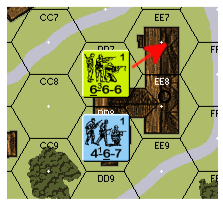
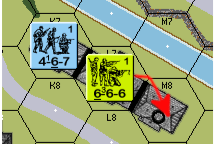
In this last example the Americans LOSE Control:
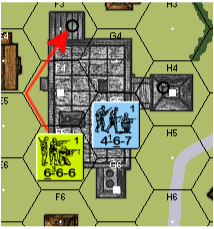
10/19/2025: Perry has confirmed our interpretation of this rule. I do not know if the rule book will adopt our exact language, if MMP even feels the need to make a change, but between our language and the examples the intent should be very clear.
If you have ANY questions on Control, please speak to Gary or Jim in advance.
- Scenario Information Sheet: Inside of each scenario pack will be an Information Sheet. This sheet will have a place to record HIP units, Covered Arcs, and other information that players are allowed to secretly record. If the information is not placed on the sheet, it did not happen. No other method of recording information is acceptable. Errors made in setup that cannot be discovered outside the course of play (e.g. HIP units) are eliminated if they cannot be verified on the Information sheet.
- All DR/dr must be made in the full view of your opponent. Dice picked up before verification by your opponent are considered not to happen. We know this is a draconian approach and we expect you as players to behave with class and sportsmanship. We beg you not to involve us in these types of discussions, but if we are asked to intervene, you know how we will resolve these types of issues.
- Any agreements and decisions made between players without interaction or input from the Tournament Director will be enforced as agreed upon. It is in your interest to append this agreement into the Scenario Information Sheet.
 HUMAN WAVE 2026